Odaban Blog


Heavy sweating
Sweating is a vital process that serves to regulate the body's temperature. It protects us from overheating and makes a significant contribution to maintaining a constant body temperature. Because: When sweat evaporates, heat is drawn from the body, resulting in a cooling effect. Sweating is therefore like our very own natural air conditioning. But what happens when the air conditioning runs at full speed even though our body does not need cooling? In Germany, about 5 million people are affected by excessive sweating. They sweat far more than is necessary for actual temperature regulation. When is sweating considered excessive? Sweat stains under the arms or beads of sweat on the forehead – excessive sweating can manifest in many different ways. The entire body or only certain areas such as the feet, back, or face can be affected. It is difficult to say exactly when sweating is excessive because the transition between normal and excessive sweating is gradual. Humans have about three million sweat glands. Depending on physical exertion, fitness level, and outside temperature, they can produce between 0.5 and 3 liters of sweat per hour. For example, well-trained athletes sweat faster and more heavily than untrained people, so they can quickly produce up to three liters of sweat during a strenuous training session. Excessive sweating, on the other hand, is generally considered to occur when the body continuously produces a lot of sweat without physical exertion and at average outside temperatures. In such cases, the affected body areas are hardly or only with difficulty kept dry. Often, those affected complain of annoying sweat stains under the arms or beads of sweat on the forehead shortly after morning washing. They usually sweat continuously from getting up until going to bed and cannot control the sweating with usual hygiene measures. The affected skin areas are continuously moist, and in cases of very heavy sweating, even wet. Even extensive body care, regular dabbing of sweat, hand washing, and moisturizing provide little relief because the sweat becomes visible again just a few minutes after hygiene measures. Possible causes Heavy sweating can initially have various causes. For reasons not yet clarified, some people's sweat glands produce sweat more frequently than is necessary within the natural metabolic processes of the body. Their sweat glands are simply overactive. While for some affected individuals, even slight stimuli such as minimally warmer temperatures or positive or negative emotions are enough to trigger sweating, others begin to sweat without any such trigger. In the search for causes, psychological factors and stress often play an important role. In addition, heavy sweating can be the result of an unhealthy lifestyle. Overweight and lack of exercise can contribute to increased sweating and negatively affect the organism. In this context, fluid intake plays a particularly important role. Those affected should definitely drink enough to compensate for the body's fluid loss through sweating. A balanced diet and regular exercise also keep metabolism in balance and thus not only improve overall well-being but can also support the natural regulation of sweat secretion.
Learn more
Sweating
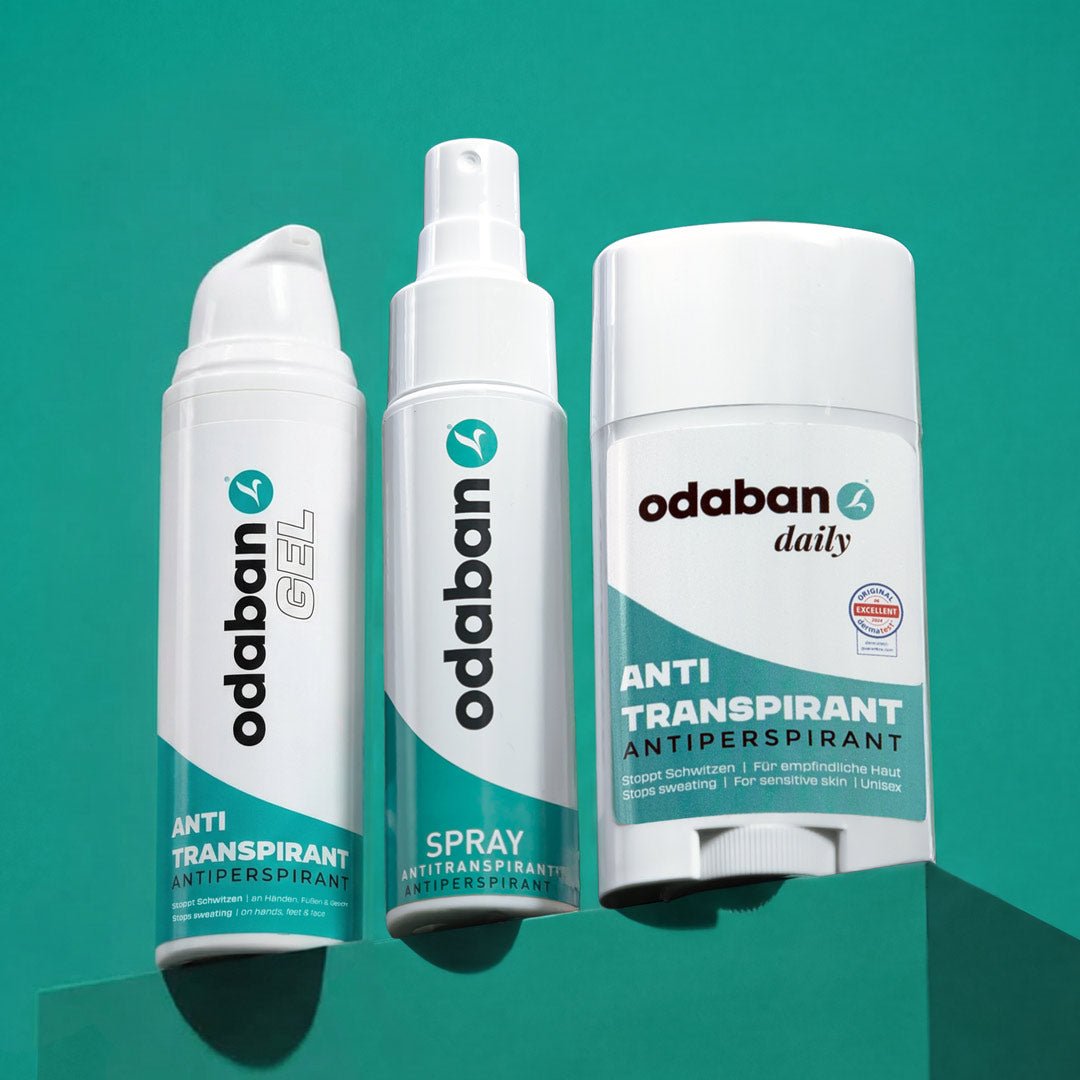
Sweating is a completely normal metabolic process of the human body, yet it can be extremely unpleasant for many people: the skin shines, sweat stains form, and eventually an unpleasant odor develops.And yet sweating has a very simple and convincing function: to cool the body, because for the sweat to evaporate, it requires energy, which comes from the heat of the skin. Sweat consists of 99% water. The composition of sweat depends on various factors, but generally, the ion concentration is lower than that of other body fluids, such as blood, which is why it is referred to as a hypotonic fluid. In addition to water, sweat contains a variety of salts (mainly NaCl and KCl in dissociated form), lactic acid, urea and uric acid, amino acids, carbonates such as formic acid or butyric acid, and also cholesterol, sugar, and ascorbic acid (vitamin C) in small concentrations. Furthermore, bicarbonate is present in sweat as an alkaline element. The pH value of sweat depends on the sweat rate. With increasing sweating, the pH value rises to alkaline levels because as the sweat flow rate increases, the concentration of lactic acid decreases and the bicarbonate concentration increases. At low flow rates, however, sweat is acidic. Excessive Sweating Those who naturally sweat very little and are largely spared from the negative effects can consider themselves lucky. Others, however, suffer from excessive sweating. 1-2% of people in Germany are affected by excessive sweat production, regardless of temperature or time of day or year. These individuals report heavy sweating episodes in situations that are hardly psychologically stressful or even "out of the blue".Often, up to 100 mg of sweat is produced in one armpit within five seconds.However, this problem is not limited to the armpits; increased sweating also frequently occurs on the hands and feet. Possible Consequences of Excessive Sweating Those affected are often very insecure in the presence of others and hesitate to offer their sweat-dampened hand. Visible sweat stains constantly form under the armpits, and despite thorough personal hygiene, sweat odor can repeatedly occur, which can be very unpleasant for partners or in professional situations. However, besides thorough personal hygiene, there are several approaches to curb excessive sweating. What Helps Against Excessive Sweating? A gentle, inexpensive, and very effective method to get the sweating problem under control is aluminum chloride, which has long been available in pharmacies usually as a deodorant roll-on solution. Aluminum chloride, in an appropriate concentration, causes the ducts of the sweat glands in the treated areas to narrow. At the same time, a complex is formed that plugs the sweat outlets like a cork, effectively regulating sweating. The media occasionally raise the question of whether aluminum in antiperspirants is harmful to health. However, since for many people only an aluminum-containing antiperspirant achieves the desired effect and the quality of life of those without an effective antiperspirant is greatly reduced, the following attempts to counter this myth. The Odaban Antiperspirant Spray , for example, releases 1.5 µg of aluminum per spray and armpit with a single application. Since Odaban Antiperspirant is applied only once or twice a week with one to two sprays per armpit each time, only about 9 µg of aluminum is released per week. This places Odaban Antiperspirant well below the systemic exposure level calculated by the Federal Institute for Risk Assessment and far below the tolerable aluminum intake for a 60 kg adult, which the Federal Institute for Risk Assessment specifies as 60.2 µg per week. The practical ODABAN® spray is applied preventively and in minimal dosage in the evening before going to bed directly to the affected skin areas. After just one application, sweating is effectively regulated. The finely tuned formula also gently and reliably protects against skin irritations such as burning or itching. With results of up to 90% less sweat flow after only three applications, the effectiveness of Odaban® spray has been dermatologically tested and confirmed by a renowned institute. During the test, subjects who all suffered from increased sweating had one armpit treated once daily in the evening with Odaban Antiperspirant for 3 days.The other armpit remained untreated during the test and served as a control. The subjects showed a reduction in sweat volume of up to 90% after 3 days of application, with an average sweat reduction of about 71%.Numerous dermatology clinics and dermatologists therefore also recommend Odaban® for severe sweating.
Learn more
Excessive sweating on the foot
Sweating is a completely natural bodily function. The body regulates its temperature in this way and keeps it within a healthy range. At the same time, sweating serves to cool the skin and the body. The amount of sweat produced varies from person to person. Excessive sweating can occur either over the entire body or locally, such as on the hands or feet. Humans have a particularly high number of sweat glands on the forehead and feet. Nowadays, our feet are mostly enclosed in socks and shoes, which often hinders heat and moisture exchange. Those who also suffer from excessive sweating face several problems: constant moisture causes the skin to swell and become susceptible to germs and fungi. As soon as bacteria break down the fresh, odorless sweat, unpleasant foot odor develops. Socks and shoes become damp and gradually ruin the footwear. This can even become so distressing that sweaty feet can be very burdensome for people and even become a "love killer." Causes of excessive sweating on the feet Excessive sweating on the feet can have various causes. Socks or shoes made of synthetic materials can hinder moisture balance, preventing enough air from reaching the skin. Therefore, one should always wear socks made of pure cotton and shoes made of materials that can quickly transport moisture outward. Proper foot care and hygiene are essential Everyone wants to avoid unpleasant odors. Proper foot care can reduce or prevent this. Daily washing or a warm foot bath is relaxing and thoroughly cleans the feet at the same time. Afterwards, the feet should be dried thoroughly. Odaban foot and shoe powder is additionally sprinkled into the shoes to take long-term and lasting action against foot and shoe odor. Odaban foot and shoe powder works with the natural power of the Kawa Kawa plant and stops annoying odors on feet and in shoes. The powder is sprinkled into the shoes to take long-term and lasting action against foot and shoe odor. To achieve long-term protection of up to 6 months, it is necessary to apply the product consistently for 7-10 days. Odaban foot and shoe powder also has antibacterial and antifungal properties.
Learn more
Causes and reasons for excessive sweating
The human body has about 3 million so-called eccrine sweat glands, which are responsible for temperature regulation and thus protect the body from overheating. They are located at the junction of the dermis and subcutaneous tissue. But how exactly does temperature regulation work? It’s quite simple. The wet sweat that emerges from the pores evaporates on our skin, creating a cooling effect. This is also known as evaporative cooling. Sweating is therefore a vital process. Even during energy production, when nutrients are burned, so much heat is generated that the body temperature inside the body would actually have to rise by about one degree per hour. Heat, physical exertion, and excitement can further increase body temperature. To prevent all these factors from causing the body to overheat, the body produces sweat – our natural and bodily cooling agent. However, some people’s sweat glands produce unnecessarily large amounts of this cooling agent. They sweat continuously and extremely heavily, even without being exposed to particular physical exertion, for example. The actual causes and reasons for excessive sweating are diverse and often difficult to identify. Excessive sweating from unknown causes For reasons not yet clarified, some people’s sweat glands produce sweat more frequently than is actually necessary for temperature regulation and energy production. It is suspected that an overfunction of the sweat glands or an overactivity of the sympathetic nervous system, which controls sweat gland production, is the underlying cause. Those affected often sweat in attacks and up to several times a day. The sweating attacks are usually limited to certain body regions, such as the armpits, soles of the feet, back, scalp, or forehead. For some people, even slight stimuli are enough to make the body start sweating. For others, sweating occurs suddenly and without a prior trigger. The intensity of sweating also varies significantly: the disorder ranges from beads of sweat on the forehead and dark sweat stains under the armpits to actual streams of sweat. Those affected are usually only troubled by the unpleasant sweating attacks during the day. At night, however, they often have no complaints. Stress as a trigger for excessive sweating Stress and emotional strain are considered one of the main causes of excessive sweating. In a milder form, almost everyone knows this phenomenon: when you are tense, excited, or nervous, the body can start to sweat. Damp, shaky hands and a few small beads of sweat at the hairline are a completely normal reaction of the body to a stressful situation. If someone is under constant pressure, this can also affect sweating. Many people who are under chronic stress complain of sudden sweating attacks, even at night. The psyche plays a decisive role in this context. Chronic stress negatively affects mental well-being and can lead to depressive moods, sleep disorders, and nervousness, among other things. Due to the psychological strain, the body consequently releases more stress hormones, which in turn give the command to produce sweat. Hormonal changes during pregnancy and menopause In addition, hormonally induced changes can also be a reason for increased sweating. During pregnancy or menopause, excessive sweating is therefore not uncommon. Especially during menopause, many women complain of sudden sweating attacks and increased sweating. It is assumed that the cause lies in the declining estrogen levels. This disrupts the hormonal balance and the body’s temperature regulation works inaccurately: the brain sends a cooling signal even though it is not actually necessary. Excessive sweating can also occur during pregnancy. Here too, hormonal changes in the body play a decisive role. The female body now has to supply not just one person but two sufficiently with nutrients. The result: the blood circulation is stimulated and body temperature rises. To compensate for the temperature increase and protect the body from overheating, sweat production is increased. Those who feel uncomfortable can counteract this with light clothing made of natural fibers and a conscious, balanced diet – but fundamentally, this is a completely normal bodily reaction. Unhealthy lifestyle Besides the causes just mentioned, lifestyle often plays a major role. To counteract excessive sweating, one should first take a close look at their own lifestyle. Do I move enough? Do I exercise? Do I eat healthily? Do I have too much stress? All these are factors that can influence sweat production. Often, it is spicy foods, too much coffee, or alcohol that rev up sweat production. Overweight is also a common cause because the extra pounds make even small movements difficult, so the body reacts even to minor exertion. However, if someone sweats excessively despite a healthy lifestyle or notices a change, they can seek advice from a general practitioner or dermatologist.
Learn more