Hyperhidrosis, antiperspirant, aluminum chloride: The odaban® sweating glossary explains 126 terms related to excessive sweating - concise, easy to understand, and with sources.
✓ 126 terms in 9 chapters✓ Each definition in two or three sentences✓ Based on guidelines, the BfR and the EU
Von A bis Z
Welchen Begriff suchst du?
Stand:
Diesen Begriff haben wir noch nicht erklärt. Schreib uns, dann nehmen wir ihn auf. Zum Kontakt
01 · Grundlagen
Schweiß & Schwitzen
Why the body sweats, where sweat comes from, and how clear water turns into odor.
Sweat is a clear, salty fluid produced by the skin’s sweat glands. It consists of around 99% water and cools the body as it evaporates from the skin.
The rest consists mainly of salt, lactic acid, and urea. Fresh sweat is virtually odorless. The characteristic odor only develops when bacteria on the skin break it down.
Sweating is the release of sweat through the skin. It protects the body from overheating and is essential for life. It becomes a problem when the body sweats significantly more than it needs to cool itself.
In English, “schwitzen” means “to sweat,” or, more formally, “to perspire.” This is where the term antiperspirant comes from.
Sweat glands are tiny glands in the skin. They produce sweat and release it to the surface through a duct. Humans have two to four million of them, with particularly high concentrations on the palms of the hands, soles of the feet, forehead, and underarms.
There are two types: eccrine and apocrine sweat glands. People who sweat heavily have neither more nor larger glands. Their glands are simply more active.
Apocrine sweat glands are found primarily in the armpits and intimate areas and only become active during puberty. Their secretion contains proteins and fats. Bacteria break it down, causing body odor.
The sweat duct is the excretory duct of a sweat gland. It ends at the skin’s surface in a pore. An antiperspirant temporarily constricts this opening, so less sweat escapes there.
Thermoregulation is the body’s ability to maintain a temperature of around 37 °C. When it gets too warm, it produces sweat. Evaporation cools the skin.
It is controlled by the diencephalon. Using an antiperspirant on small areas such as the underarms, hands, or forehead does not interfere with thermoregulation: the rest of the body continues to sweat.
Thermal sweating is sweating caused by heat or physical activity: in hot weather, during exercise, with a fever, or in a sauna. It affects the entire body and serves to cool it down.
Emotional sweating isn’t caused by heat, but by tension: stress, excitement, anxiety or embarrassment. It mainly affects the hands, feet, underarms and forehead - often within seconds.
Typical situations include job interviews, presentations, or first dates. Sweating itself then makes you even more nervous.
Gustatory sweating is sweating during or shortly after eating, usually on the forehead, scalp, and upper lip. Spicy foods, hot drinks, alcohol, and coffee are the most common triggers.
If it occurs on the cheek after surgery on the parotid gland, it is called Frey syndrome.
A sudden sweating episode is intense sweating that develops within seconds to minutes. Triggers include heat, physical exertion, stress, hot flashes during menopause, low blood sugar, or infections.
Body odor occurs when bacteria on the skin break down components of sweat. Fresh sweat has little to no smell. Where less sweat is produced, less odor develops.
Deodorant only masks the smell. An antiperspirant reduces the sweat itself, removing the basis bacteria need to thrive.
The skin microbiome is the community of bacteria and fungi that naturally live on the skin. It protects the skin. However, some of its bacteria break down sweat, producing odor.
The autonomic nervous system controls bodily functions you cannot consciously influence - including sweating. The sympathetic nervous system, a part of this system, signals the sweat glands to produce sweat via the neurotransmitter acetylcholine.
That’s why you can’t simply “think away” sweating - and why you sweat when you’re stressed, even when it isn’t warm.
Electrolytes are dissolved minerals such as sodium, potassium, and magnesium. When you sweat, your body primarily loses salt - which is why sweat tastes salty.
When you sweat heavily in hot weather or during exercise, replace lost fluids by drinking and replenish salt through food.
Hyperhidrosis is the medical term for sweating that goes beyond what the body needs for temperature regulation. The key factor is not the amount of sweat, but the disrupted control mechanism.
In Germany, around one in 20 people is affected by the primary form. Hyperhidrosis is classified as primary or secondary, and focal or generalized.
It is diagnosed by a general practitioner or dermatologist.
Primary hyperhidrosis is excessive sweating without any identifiable underlying condition. It usually begins in childhood or adolescence, occurs on both sides of the underarms, hands, feet, or forehead, and stops during sleep.
Secondary hyperhidrosis is excessive sweating caused by an underlying condition - such as an overactive thyroid, diabetes, infections, menopause, or certain medications.
It often affects the whole body and also occurs at night. If excessive sweating suddenly begins in adulthood, have the cause evaluated by a doctor.
Focal hyperhidrosis is excessive sweating in specific areas of the body - typically the underarms, palms, soles of the feet, forehead, or groin. The rest of the body sweats normally.
Generalized hyperhidrosis affects the entire body or large areas of the skin. It is more often caused by an underlying condition than the focal form, so it should be evaluated by a doctor.
Axillary hyperhidrosis is excessive sweating in the armpits (Latin axilla = armpit). It is the most common form of focal hyperhidrosis and is evident from sweat stains on clothing.
Plantar hyperhidrosis is excessive sweating on the soles of the feet (from the Latin planta = sole of the foot). It often occurs together with sweaty palms.
Night sweats are excessive sweating during sleep that soaks through your pajamas or bed linen. Common causes include a bedroom that’s too warm, alcohol, infections, menopause, or medication.
Primary hyperhidrosis pauses during sleep. If night sweats persist for weeks or are accompanied by fever and weight loss, have them checked by a doctor.
Bromhidrosis is the medical term for excessively unpleasant-smelling sweat. The odor develops when bacteria break down sweat on the skin - most commonly in the armpits and on the feet.
Chromhidrosis is a very rare condition in which colored sweat is produced - yellow, green, blue, or black. It has nothing to do with yellow sweat stains on clothing.
Anhidrosis means that the skin in one area or across the entire body does not produce sweat. With hypohidrosis, it produces too little. Without this cooling mechanism, heat can build up in hot weather - both conditions require medical attention.
Compensatory sweating is increased sweating in other areas of the body - usually the back, abdomen, or legs - after surgery on the sympathetic nerve. It is the most common side effect of this procedure.
With an antiperspirant you apply to your skin, this isn’t the case: it only works where applied.
Frey syndrome causes sweating and flushing on the cheek while eating. It usually develops after surgery or an injury to the parotid gland, when nerve fibers reconnect incorrectly.
Heat rash consists of small, often itchy blisters or red spots. It develops when sweat cannot evaporate in hot weather and becomes trapped in the skin - often beneath tight clothing.
They usually heal on their own as long as the skin stays cool and dry. Have a persistent or oozing rash checked by a doctor.
Intertrigo is inflammation in skin folds - under the breasts, in the groin, between the thighs, or on the buttocks. It occurs when skin rubs against skin and sweat cannot evaporate.
The area is red, burning, or oozing. Fungi and bacteria can easily take hold. Do not apply antiperspirant to irritated or sore skin.
Dyshidrosis is a type of eczema that causes small, intensely itchy blisters on the palms of the hands, sides of the fingers, or soles of the feet. Despite its name, current understanding indicates that it has nothing to do with a disorder of the sweat glands.
The HDSS is a four-level scale. It allows people affected to assess how much sweating interferes with their daily lives - from “never noticeable” (level 1) to “unbearable, always disruptive” (level 4).
Gravimetry measures the amount of sweat by weight: A filter paper or pad absorbs sweat over a set period of time. It is weighed before and after, and the difference is the amount of sweat.
The iodine-starch test shows exactly where the skin is sweating: The area is coated with an iodine solution and dusted with starch powder. Wherever sweat appears, it turns dark.
Underarms, hands, feet, face: Every area has its name - and its own solution.
auch: underarm sweatiness
Underarm sweat is sweat from the armpits. There are particularly many sweat glands there, and moisture evaporates poorly under the arms - resulting in sweat stains and odor.
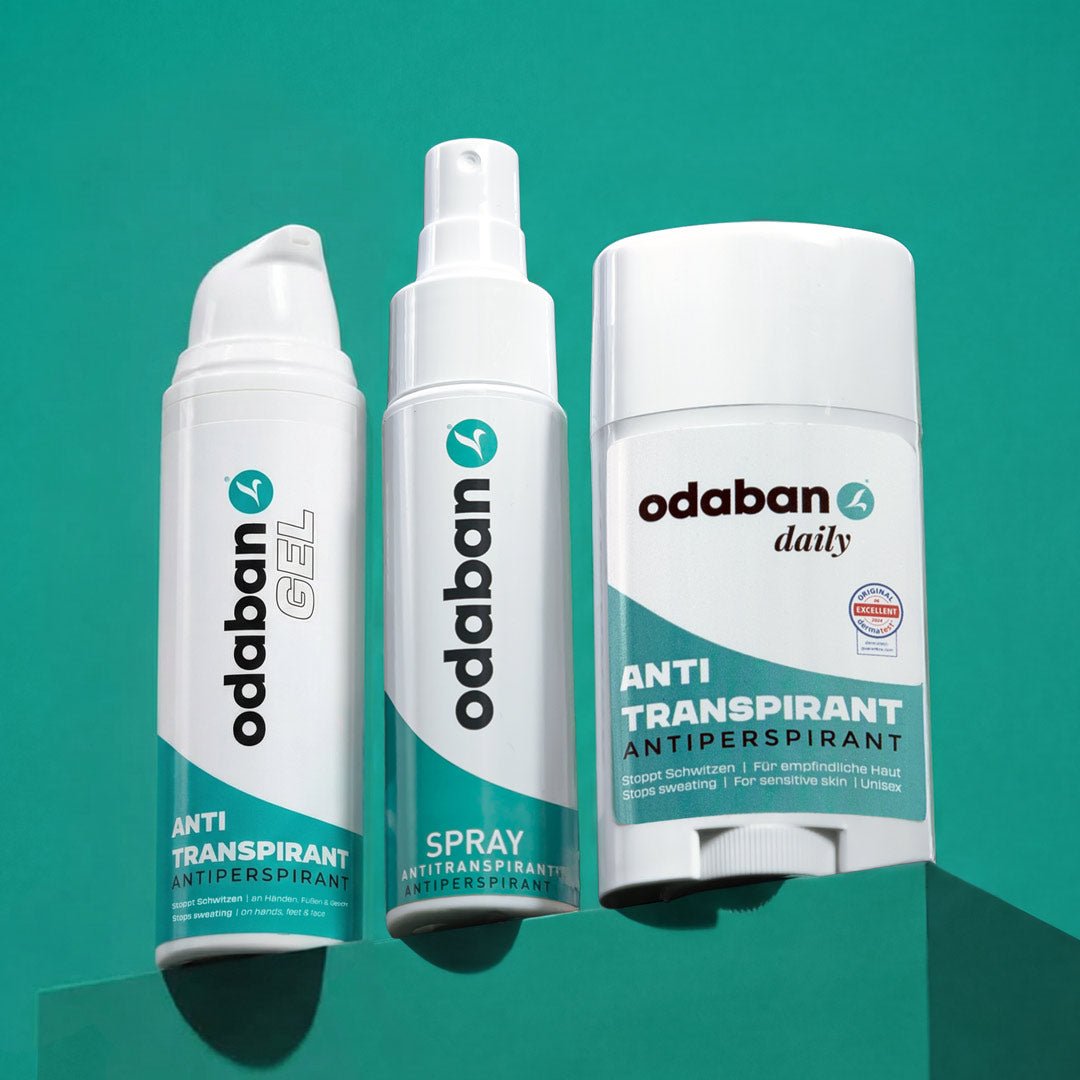
Apply odaban® Spray to your underarms in the evening. For everyday use, choose the odaban® daily Antiperspirant Deo Stick.
Sweaty hands mean your palms are constantly damp or wet, regardless of the temperature. Stress and excitement make them worse. A handshake becomes a source of stress.
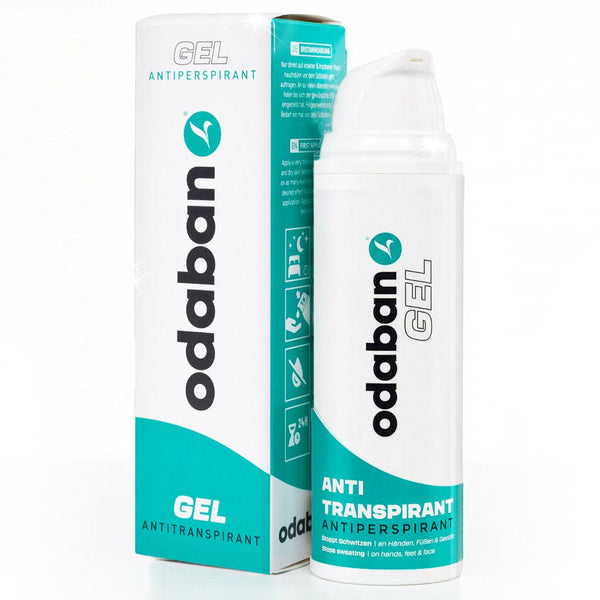
For the hands, we recommend odaban® Gel: in the evening, apply a small amount to clean, dry palms and leave it on overnight.
Sweaty feet are excessively perspiring soles and spaces between the toes. In closed shoes, moisture builds up and bacteria break down the sweat - causing odor.
In the evening, apply odaban® Gel to dry feet and sprinkle odaban® Foot and Shoe Powder into your shoes.
Foot odor occurs when bacteria break down sweat and dead skin cells in the warm, damp environment of shoes. The longer your feet and shoes stay damp, the stronger the odor becomes.
What helps: Change shoes daily and let them dry thoroughly, wear socks made of merino wool or performance fibers, and sprinkle odaban® Foot and Shoe Powder into your shoes.
Facial sweating is sweat on the forehead, upper lip, nose, or temples. It’s immediately noticeable, impossible to hide, and makes makeup and sunscreen run.
On your face, treat only specific areas such as the forehead: in the evening, apply a small amount of the precisely dosed odaban® Gel. Avoid the eye area and do not exfoliate beforehand.
Back sweat is sweating on the back and between the shoulder blades. Heat builds up under a backpack, blazer, or against a seat back - and your shirt sticks to your skin.
Under-breast sweating occurs in the skin fold where skin touches skin and sweat can barely evaporate. The result is damp patches in the bra, chafing, and sometimes a red, burning rash.
Sweating in the intimate area affects the groin and crotch. Many sweat glands are located there, the skin is in close contact, and heat builds up under tight clothing.
Important: odaban® is not intended for intimate areas or mucous membranes. Breathable cotton underwear and thorough drying can help.
Sweating around the buttocks is perspiration in the gluteal crease and on the areas that come into contact with a seat. It occurs primarily during prolonged sitting, in hot weather, and when wearing tight clothing made from synthetic fabrics.
Hormones, infections, food, medications: what else makes the body sweat.
auch: Menopause
Menopause refers to the years of hormonal changes around your final period. As estrogen levels drop, your body’s temperature regulation can become disrupted. Hot flashes and night sweats are the most common symptoms.
Hot flashes are sudden waves of heat that rise from the chest and neck to the face - often accompanied by flushing, a racing heart, and a sudden bout of sweating. They usually last a few minutes and are typical during menopause.
During puberty, the apocrine sweat glands become active. Teenagers then sweat more, and their sweat develops an odor for the first time. Primary hyperhidrosis also often begins at this age.
During pregnancy, metabolism and blood circulation increase. As a result, many women sweat more, especially at night. During the first few weeks after giving birth, many women sweat even more; it usually returns to normal afterward.
If you are pregnant or breastfeeding, please consult your doctor before using odaban®.
With an overactive thyroid, the thyroid gland produces too many hormones. The metabolism goes into overdrive: people affected sweat heavily, tolerate heat poorly, experience palpitations, and often lose weight.
A blood test at your doctor’s office can determine whether your thyroid is the cause. Feeling cold is more typical of an underactive thyroid than sweating.
Hypoglycemia means your blood sugar is too low. Typical signs include cold sweats, trembling, intense hunger, and a racing heart. It mainly affects people with diabetes who take insulin or certain tablets.
When you have a fever, your body raises its set point. As the fever subsides, it releases excess heat through sweating. That’s why you sweat when you have a cold or the flu - often at night.
Drinking enough fluids compensates for fluid loss.
Some medications can increase sweating as a side effect - including certain antidepressants, painkillers, hormone treatments, and blood sugar-lowering medications.
Never stop taking a prescribed medication without consulting your doctor. Talk to your doctor if you suspect a connection.
Alcohol is a common trigger for sweating: it dilates the skin’s blood vessels and raises your heart rate. The body releases more heat and you sweat. Many people notice this as night sweats after an evening of drinking.
Capsaicin is the compound that makes chilies hot. It stimulates the heat receptors in your mouth and skin. Your body reacts as if it were exposed to heat - and you sweat, especially on your face and scalp.
During exercise, your muscles generate heat, and your body cools itself through sweat. Trained athletes start sweating sooner and more than untrained people: their bodies have learned to cool down faster.
What an antiperspirant is, what’s in it - and why deodorant is something completely different.
auch: Antiperspirant, sweat inhibitor
An antiperspirant is a cosmetic product that reduces the amount of sweat produced on the treated area of skin. Its active ingredient, an aluminum salt, temporarily constricts the openings of the sweat glands.
Less sweat also means less odor and fewer sweat stains. Deodorant, on the other hand, does not prevent sweating or sweat stains and only masks odor.
odaban® is an antiperspirant - since 1970, trusted by pharmacies.
Antiperspirant is another word for antitranspirant. It comes from English (to perspire = to sweat) and appears on many international products. The effects and active ingredients are the same.
Aluminum salts are the active ingredients responsible for an antiperspirant’s sweat-blocking effect. The most important ones are aluminum chloride and aluminum chlorohydrate.
The EU Scientific Committee on Consumer Safety (SCCS) considers aluminum compounds in antiperspirants safe up to specified maximum levels.
Aluminum chloride is an aluminum salt and has been the most widely used active ingredient in high-strength antiperspirants for decades. It binds to proteins in the skin’s outermost layer and forms a fine plug at the opening of the sweat duct.
Aluminum chlorohydrate is the aluminum salt found in most antiperspirants for everyday use and has been for decades. It is milder than aluminum chloride.
The odaban® daily antiperspirant deodorant stick contains aluminum chlorohydrate.
In 2023, the German Federal Institute for Risk Assessment reassessed antiperspirants containing this active ingredient: adverse health effects from aluminum absorption through the skin are unlikely.
“Aluminum-free” means the product contains no aluminum salts. Such products are generally deodorants. They do not prevent sweating or sweat stains; they only mask odor.
The sweat-reducing effect of an antiperspirant is based on aluminum salts.
The plug is the fine seal through which an antiperspirant works: aluminum salts and skin proteins form it at the opening of the sweat duct. It lasts for several days and then dissolves on its own.
The blockage sits at the opening of the duct, not on the skin. That’s why it remains even after showering. The effect is temporary: if you stop using the antiperspirant, the area will sweat as before.
In everyday language, “clinical antiperspirant” refers to especially powerful antiperspirants traditionally sold in pharmacies. Typical use: apply in the evening, leave on overnight, then use just once or twice a week after the initial phase.
A cosmetic is a product applied externally to cleanse, care for, or protect the body, or to influence body odor. Antiperspirants and deodorants are cosmetics, not medicines.
They are available without a prescription. You can get odaban® in the online shop, at pharmacies, at Rossmann, and at dm and BIPA in Austria.
INCI is the internationally standardized naming system for cosmetic ingredients (International Nomenclature of Cosmetic Ingredients). They are listed on the packaging in descending order by quantity; ingredients present at less than 1% may be listed in any order.
The INCI names are the same in all countries and are not translated.
An antiperspirant spray is a liquid antiperspirant in a spray bottle. It can be applied sparingly and is suitable for the underarms and other areas of the body.
odaban® Spray is fragrance-free. Spray once onto a cotton pad and dab it onto completely dry skin in the evening.
An antiperspirant stick is a solid stick that you apply directly to your skin. Unlike a deodorant stick, it contains an aluminum salt and reduces the amount of sweat.
The odaban® daily Antiperspirant Deo Stick is gentler than the spray and designed for daily use. One or two swipes are all you need.
A roll-on applies a liquid directly to the skin via a ball applicator. The format says nothing about its effectiveness: what matters is whether it contains an aluminum salt - only then is it an antiperspirant.
odaban® is available as a spray, gel, stick, and wipes.
Shoe powder is sprinkled into shoes. It absorbs moisture and helps fight odor.
Thanks to sage, odaban® foot and shoe powder has a mild sweat-reducing effect. However, only an antiperspirant such as odaban® Gel can truly stop sweating on the feet.
Tannins are plant compounds that gently tighten the skin. They are found in oak bark, sage, and black tea and have traditionally been used in hand and foot baths.
Home remedies for sweating include sage tea, foot baths with black tea or oak bark, baking soda, and apple cider vinegar. They may help reduce odor and refresh the skin. However, there is no evidence that they significantly reduce the amount of sweat.
If you want to reduce the amount you sweat, you need an antiperspirant.
In the evening, on dry skin, and sparingly: That’s how to apply an antiperspirant.
Apply a powerful antiperspirant in the evening before going to bed. You sweat the least at night, so your skin is dry and the active ingredient can work undisturbed.
Shower as usual in the morning. The protection stays.
The initial phase consists of the first few evenings when you apply an antiperspirant daily until effective protection has built up. For odaban® Spray and Gel, this means 3 to 5 consecutive evenings.
The duration of effectiveness is how long an antiperspirant’s protection lasts. odaban® Spray works for several days - even after showering, because it blocks the opening of the sweat duct rather than sitting on the skin.
Residual moisture is the moisture that remains on your skin after showering or from light sweating. Apply antiperspirant only to completely dry skin: it is less effective on residual moisture and may cause skin irritation.
If the area is still slightly damp in the evening, dry it beforehand with a hair dryer on the lowest setting.
The dosage is the amount you apply. With a strong antiperspirant, less is more. For odaban® Spray, one spray per underarm is enough - spray it onto a cotton pad and dab it on; do not spray directly onto the skin.
Applying more doesn't work better, but it can irritate the skin.
Burning, itching, or redness may occur during the first few nights, especially with extra-strength antiperspirants. In most cases, the skin was still damp or freshly shaved, or too much product was applied.
Take a break, then apply the antiperspirant less frequently and more sparingly.
Spray in the evening, stick in the morning: odaban® Spray builds protection overnight, while odaban® daily Antiperspirant Deodorant Stick keeps you protected throughout the day.
On the days you don't use the spray, simply use the stick.
From iontophoresis to surgery: the medical treatments used for hyperhidrosis.
auch: Dermatologist
Dermatologists are specialists in skin health and, therefore, in sweat glands too. If you sweat excessively, your first point of contact should be your GP or dermatologist: They can determine whether you have hyperhidrosis and which treatment is right for you.
The S1 guideline “Definition and Treatment of Primary Hyperhidrosis” is the treatment recommendation of the German Society of Dermatology (as of 2023). It outlines the diagnostic and treatment steps.
Among topical treatments, aluminum chloride is the first-line option. Other treatments include iontophoresis, botulinum toxin, tablets, and surgical procedures.
Iontophoresis is a treatment that uses a weak electrical current in a water bath, primarily for sweaty hands and feet. Initially, 20 to 30 minutes several times a week are required; later, once or twice a week - on an ongoing basis.
It is not suitable for people with pacemakers, metal implants, or during pregnancy.
Botulinum toxin blocks the transmission of signals from the nerves to the sweat glands. It is injected into the skin and works for several months. Usually, one to two treatments per year are needed.
In Germany, it is approved for severe underarm hyperhidrosis when topical treatments are not sufficient.
Anticholinergics are prescription-only medications, usually tablets. They inhibit the neurotransmitter acetylcholine, thereby reducing sweating throughout the body. The most common side effect is dry mouth.
Glycopyrronium cream is a prescription cream for excessive underarm sweating. It blocks the nerve signal to the sweat gland and has been approved in Germany since 2022.
Sweat gland removal is a surgical procedure performed under local anesthesia. Sweat glands in the armpit are suctioned out and scraped away through small incisions.
Sympathectomy is a surgical procedure in which sympathetic nerve pathways in the chest are cut or clamped. The most common side effect is compensatory sweating in other parts of the body.
The guideline does not recommend it as the first-line option.
In microwave and radiofrequency therapy, the sweat glands in the armpits are destroyed by heat. These procedures are still relatively new. Long-term data spanning several years is not yet available.
Who evaluates antiperspirants, what a seal means, and what you can rely on.
auch: German Federal Institute for Risk Assessment
In Germany, the BfR assesses the health risks of food, chemicals, and consumer products. Its 2023 assessment of antiperspirants containing aluminum chlorohydrate concluded: Adverse health effects from aluminum absorption through the skin are unlikely.
The SCCS is the European Commission’s Scientific Committee on Consumer Safety. It assesses the safety of cosmetic ingredients. It considers aluminium compounds in antiperspirants safe up to specified maximum levels.
The EU incorporated these maximum levels into the Cosmetics Regulation in 2026 (Regulation (EU) 2026/909).
The TWI is the amount of a substance a person can consume every week over a lifetime without expected adverse health effects. For aluminum, the European Food Safety Authority (EFSA) has set it at 1 mg per kilogram of body weight per week.
We take in most of it through food. According to the BfR, antiperspirants contribute very little.
The EU Cosmetics Regulation sets out which substances are permitted in cosmetics, the maximum amounts allowed, and how products must be labelled. It applies to all antiperspirants and deodorants in the EU.
An efficacy test measures how much an antiperspirant reduces sweat production. The standard method is a half-side comparison: one armpit is treated, while the other is left untreated; the amount of sweat is measured gravimetrically.
odaban® Spray tested in 2012: an average of 71% less underarm sweat after three applications (8 test subjects).
“Dermatologically tested” means that a product has been tested on participants under dermatological supervision for skin compatibility. The seal assesses tolerability, not effectiveness.
The odaban® Spray was tested by dermatest in 2014 in a patch test involving 30 people and received an “excellent” rating. The antiperspirant deodorant stick and shoe powder were also tested by dermatest.
A patch test is a skin test in which substances are applied to the skin under a patch. Doctors use it to detect contact allergies; for cosmetics, it is used to assess skin compatibility.
Sensitive skin is more prone to redness, burning or itching. That’s why you should test a new antiperspirant on a small area first and apply only a small amount.
What you see, what you wear, and what makes a difference in everyday life.
auch: Sweat marks, sweat stains
Sweat stains are damp, dark patches on clothing - usually under the arms, on the back, or across the chest. They occur when the fabric absorbs more sweat than can evaporate.
Deodorant doesn’t prevent sweating or sweat stains - it only masks odor. An antiperspirant works earlier: less sweat, fewer stains.
Yellow sweat stains form in light-colored fabrics when sweat, body oils, and residue from deodorant or antiperspirant build up in the fibers over repeated washes.
Prevent: Let the product dry completely before getting dressed, and wash worn clothing soon afterward.
Fresh sweat stains come out in a normal wash if you wash the clothing soon. Soak yellow and older stains before washing - for example, with bile soap or citric acid.
Follow the care label and always test any product on a hidden area first. Wash silk and wool only with a mild detergent.
Deodorant stains are light-colored residue on dark clothing. They occur when deodorant or antiperspirant has not yet dried and transfers onto the fabric.
Let the spray and gel dry or absorb completely before getting dressed - otherwise, discoloration may occur.
A performance undershirt is an undershirt with absorbent zones in the underarms or on the back. It absorbs sweat before it reaches the shirt or blouse worn over it.
Viscose is a cellulose-based fiber. It’s smooth, lightweight, and highly absorbent - much more so than polyester. However, wet spots can quickly show through thin viscose.
Modal and lyocell are related fibers with similar properties.
Polyester is a synthetic fiber that absorbs very little moisture. In dense fabrics, heat builds up and odors cling more easily. However, polyester performance fabrics are designed to wick sweat away from the skin.
What is the difference between deodorant and antiperspirant?
Deodorant does not prevent sweating or sweat stains; it only masks the odor. Antiperspirant constricts the openings of the sweat glands, significantly reducing the amount of sweat released. Where there is little sweat, there is usually little odor. Compare them
What is hyperhidrosis?
Hyperhidrosis is the medical term for sweating beyond what the body needs for temperature regulation. The primary form usually affects the underarms, hands, feet, or forehead and begins in childhood or adolescence. In Germany, around one in twenty people is affected.
How does antiperspirant work?
Overnight, the active ingredient bonds with proteins in the outermost layer of skin and forms a fine plug in the opening of the sweat duct. This significantly reduces the amount of sweat released from the treated area. The effect lasts for several days and then wears off on its own. How odaban® works
What is aluminum chloride?
Aluminum chloride is an aluminum salt and has been the most commonly used active ingredient in strong antiperspirants for decades. It forms a fine plug in the opening of the sweat duct. The odaban® Spray contains aluminum chloride.
Is aluminum in antiperspirant a concern?
The EU Scientific Committee on Consumer Safety (SCCS) considers aluminum compounds in antiperspirants safe up to specified maximum levels; in 2026, the EU incorporated these maximum levels into the Cosmetics Regulation. The German Federal Institute for Risk Assessment considers adverse health effects from antiperspirants containing aluminum chlorohydrate unlikely. More about aluminum
Why do you apply antiperspirant in the evening?
You sweat the least at night. Your skin is dry, allowing the active ingredient to work undisturbed. In the morning, wash the area as usual; the protection remains. How to use it
Does antiperspirant damage the sweat glands?
The effect is temporary. The plug sits in the opening of the sweat duct and dissolves after a few days. If you stop using the antiperspirant, the area will sweat as before.
When should I see a doctor about excessive sweating?
If heavy sweating suddenly starts, affects your entire body, occurs mainly at night, or is accompanied by fever, weight loss, or palpitations. Another cause may be behind it. Your first point of contact should be your GP or dermatologist.
60-day money-back guarantee on spray, gel & shoe powder.
This glossary is for general information and is not a substitute for medical advice. If excessive sweating suddenly develops or is accompanied by other symptoms, please have it checked by a doctor.
odaban® is a cosmetic product. Apply only to intact, dry skin - not immediately after shaving.
DermaTronnier, Institute for Experimental Dermatology at Witten/Herdecke University: odaban® Spray efficacy test, report dated 16 April 2012, 8 test subjects.
Skin compatibility
Dermatest GmbH, Münster: odaban® Spray epicutaneous test, 28 April 2014, 30 test subjects, rated “very good”.